

B2C (business-to-consumer) companies invest around 9.6% of their revenue in their marketing efforts, and B2B (business-to-business) firms invest even more at 11.8%. With such a big portion of budgets going to marketing, these companies need to know how to lower customer acquisition cost without spending blindly. One effective way to do that is to use and calculate advertising metrics.
Customer acquisition cost (CAC) is widely regarded as one of the most important metrics in marketing. In this guide, we explore why it’s important to calculate it, how to calculate it, and five ways to reduce it.
- What is CAC & why should you measure it?
- How to calculate CAC
- How to lower CAC: 5 bulletproof methods
What is customer acquisition cost & why should you measure it?
CAC covers how much a company has to spend to get a new customer. These costs can vary by campaign, channel, and even time of year. CAC is a key metric for all businesses to measure. It tells you exactly how much you’re spending to convert leads into customers.
Calculating and regularly measuring CAC also helps companies understand how effective their marketing strategy is. That’s because it directly reflects the performance of their marketing and sales campaigns.
In short, calculating CAC helps businesses see whether they’re getting a good return on their investment in growing their customer base. With that information in hand, they can better strategize how to reduce these costs.
How to calculate customer acquisition cost
CAC is a simple metric to calculate. All you need to do is add together the total expenses involved in converting prospects into customers. Then divide that amount by the total number of new customers acquired in a given time period.
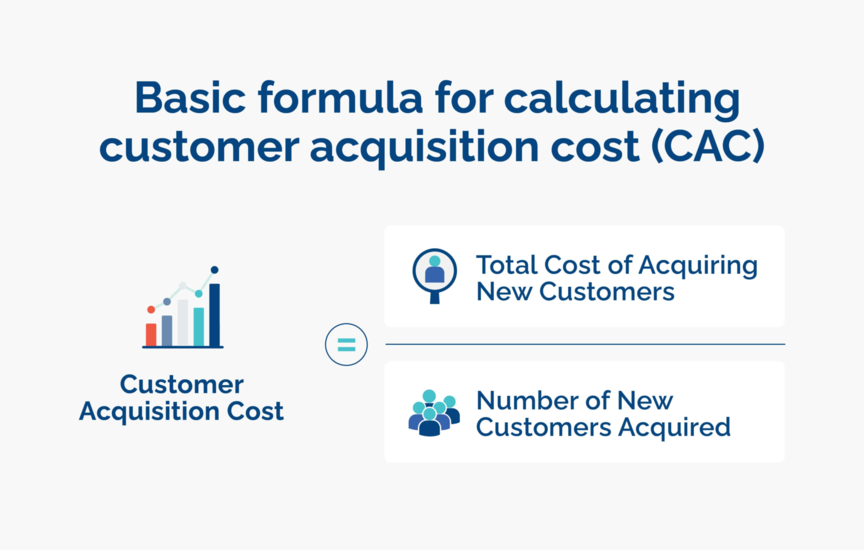
For example, if you spend $5,000 in one month and acquire five new customers, your customer acquisition cost is $1,000.
What costs are involved in acquiring new customers?
The formula for calculating CAC is straightforward. Identifying all the costs involved in growing your customer base is the tricky part.
Here’s what you need to include in the cost of acquiring new customers:
- Paid sales and marketing staff
- Social media campaigns
- Paid marketing costs such as Google Ads, Facebook, and agency fees
- Any equipment or tools
When calculating CAC, it’s also incredibly important to take into account the business context. For example, if you’ve just hired new marketing staff, your CAC will be significantly higher. The same goes if you’re augmenting your current marketing efforts with new technologies.
How to lower customer acquisition cost: 5 bulletproof methods
CAC is a great indicator of profitability. Your CAC should be 33% or less of your Customer Lifetime Value (CLV), or your business won’t be viable.
By knowing your CAC, you can act and strategize to reduce those costs and increase your return on investment (ROI). Here are five methods to lower your CAC.
1. Use a customer relationship management (CRM) system
A CRM helps you remain engaged with your audience, fix leaks in your funnel, and improve your outreach to prospective customers.
By organizing your customers within a CRM, you can also keep track of your leads throughout the funnel and ensure they convert. Remember, the earlier you engage a customer, the lower the final acquisition cost.
2. Target the right audience
When you run highly-targeted campaigns, you’re better placed to reach the right audience and avoid wasting resources on unqualified targets. That means knowing your customers and their wants and needs. It also means creating timely, relevant messages for potential prospects.
However, this also ensures you’re targeting real human users rather than bots and fake leads. An invalid traffic detection solution can easily solve this problem, preventing invalid leads from entering your traffic.
3. Focus on converting prospects into paying customers
Not only should you target the most profitable audience, but you should also make sure that they convert into paying customers.
Start at the beginning: check that your landing pages are engaging, provide a smooth user experience, and include relevant calls to action. By improving the overall user experience, you can keep attracting new customers and increase your conversion rate.
4. Prioritize your channels and partners
Comparing your channels and allocating your budget to the most profitable ones helps you keep your CAC as low as possible. By weeding out channels where campaigns underperform or bring low-quality traffic, you can automatically reduce your CAC. Plus, by focusing on the highest-performing channels, you can make them even more efficient.
Additionally, solutions like Opticks enable you to compare channels based on the rates of advertising fraud within them. This helps you reduce the chance of invalid traffic, therefore reducing your CAC.
5. Partner with affiliate and influencer programs
Affiliate and influencer programs are an effective way to reduce your CAC by tapping into their reach to engage a larger audience. Since you only pay affiliates and influencers a percentage-based commission after customers convert, you can boost sales at a lower cost.
However, investing in these programs can get costly if the traffic they generate includes invalid leads. That covers fake contacts and contacts whose data has been stolen.
Solutions like Opticks can automatically detect the presence of invalid traffic and prevent it from entering your database. This ensures that you don’t get charged by illegitimate partners and also protects your overall brand reputation.
Opticks can help you lower your CAC and improve your ROAS
When it comes to the health of your marketing budgets, CAC is an essential metric to calculate and optimize. Anti-ad fraud solution Opticks can help you block invalid traffic before it adds to your CAC. That also helps protect your return on ad spend (ROAS).
Find out more about how the expert team at Opticks can improve your CAC and campaigns. Contact us or click here to start your free trial.