


Black Friday, one of the biggest sales periods of the year, lands on November 27th, 2026. What was once a single day in November has turned into a week-long stretch of huge shopping sales, running straight through Cyber Monday on December 1st.
For digital advertisers, Black Friday kicks off the holiday season and offers a huge opportunity to capitalize on above-average online spending. Fraudsters know it too, and they time their attacks to match.
Months of campaign and budget planning lead up to this event. Fraudsters are lying in wait to follow its massive money trail.
Opticks’ 2025 Annual Ad Fraud Report found that fraud consistently concentrates around Black Friday, Cyber Monday, and December, the weeks with the most ad spend at stake. Paid Social campaigns (Meta) run 10.61% invalid traffic, nearly 5x higher than Paid Search (2.18%).
Opticks, 2025 Annual Ad Fraud Report
If you’re running Black Friday campaigns this year, be aware: ad fraud can easily derail your targets. Here, we break down what past Black Fridays show us, and exactly how fraudsters move to annihilate your campaigns and your budget.
What Black Friday ad fraud actually looks like
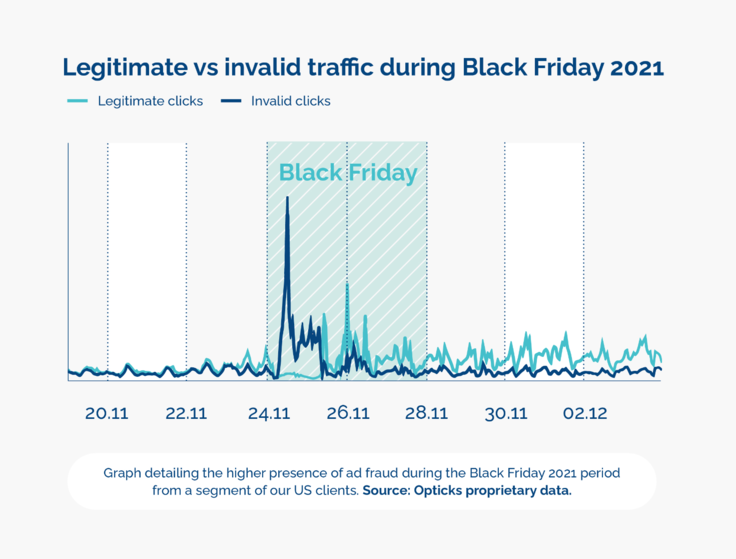
Opticks first spotted this pattern by analyzing how ad fraud activity affected traffic during Black Friday 2021, tracking the data from one week before to one week after. Its 2025 Annual Ad Fraud Report confirms the same spike repeats every year.
In the graphic below, the darker line represents ad fraud activity seen in the traffic of Opticks’ US-based clients. There is a huge spike leading up to Black Friday, as well as on the day itself, a pattern that repeats every year.
Why ad fraud spikes around Black Friday
Here’s what drives that spike:
- As an advertiser, you most likely invest a huge share of your ad budget during Black Friday week. You’re not the only one. Traffic suppliers face a surge in demand they can’t always meet with real human traffic. When supply runs short, some partners compensate by leaning on fraudulent sources and fake traffic instead.
- In other words, when good traffic drops, publishers often turn to more fraudulent sources to meet demand. That’s why fraudulent traffic increases and can outpace valid traffic during the spike.
- When there’s plenty of good supply (lots of people browsing), bad traffic diminishes too, though rarely in proportion.
Traffic typically returns to normal levels within a few days, around Cyber Monday. Ad fraud rates fluctuate right alongside it, every single year.
This data shows just how dangerous Black Friday can be for advertisers without an anti-ad fraud solution in place. Without one, fraudsters can attack your campaigns freely.
Secure your campaigns against seasonal scammers with proactive ad fraud prevention
Are you ready for Black Friday on November 27th, 2026? More importantly, are your campaigns protected against ad fraud?
Ad fraud is rife during Black Friday and beyond, making prevention especially relevant during the holiday shopping season. Fraudsters expect traffic to increase, and Black Friday gives them the perfect conditions to steal more of your ad spend.
💡You may also like: Click Fraud in E-commerce: How Bots Quietly Drain Google & Meta Budgets During Peak Season
Why these fraud spikes go unnoticed
You might notice large spikes in unusual traffic on a “normal” day. But Black Friday is a huge event that naturally sees increased traffic from expanded campaign parameters. That makes these anomalies easy to miss, exactly when they’re the most expensive.
3 reasons to act before Black Friday 2026 arrives
Here are just a few reasons to implement an anti-ad fraud solution before Black Friday arrives:
- To protect your ad spend: Anti-ad fraud solutions stop fraudsters from siphoning off your budget by detecting and preventing tactics such as fraudulent redirects, bots, and click spamming.
- To help you reach your targets: Ad fraud skews campaign statistics and data, for example, high click rates paired with low conversions. That can convince advertisers their campaigns aren’t working, leading them to waste resources on unnecessary adjustments.
- To protect your key KPIs: The combination of wasted ad spend, missed targets, and skewed analytics adds up to a hugely reduced return on investment. Our own data shows ad fraud can cause an 11% reduction in return on ad spend (ROAS) and a 9% increase in customer acquisition cost (CAC). See the full picture in our ad fraud benchmarks.
As fraudsters continue to refine their already sophisticated tactics, robust anti-fraud solutions like Opticks become essential. They’re the technology that protects your campaigns during Black Friday and all year round.
Don’t let fraudsters cash in on your Black Friday budget. See exactly how much of your spend is at risk before November 27th.
Comments
One response to “How to Protect Your Campaigns Against Ad Fraud During Black Friday”
[…] campaign window leaves less time to catch anomalies before the sale ends, a pattern we first documented around Black Friday traffic spikes and keep seeing every year […]