


E-commerce click fraud rarely looks dramatic. Every peak season, e-commerce teams raise budgets, tighten bidding, and watch revenue dashboards more closely than ever. Few watch invalid-traffic reports at the same time. That is exactly where bots and click farms do the most damage, quietly, in the exact weeks when the most money moves through Google and Meta.
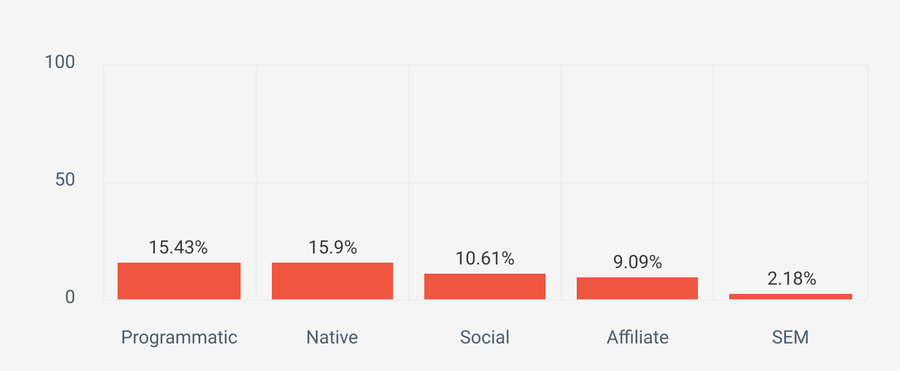
Chart from Opticks’ 2025 Ad Fraud Report (By Channel, page 10).
KEY TAKEAWAYS
- E-commerce overall runs 9.65% invalid traffic, but most of that is direct scraping, not paid clicks.
- Paid Google Search (SEM) stays clean at 2.18% invalid, one of the lowest rates Opticks tracks.
- Paid Social, the category covering Meta, runs 10.61% invalid: nearly 5x higher than Search.
- 81.7% of fraudulent e-commerce conversions are non-compliant traffic, not obvious bots.
- Fraud concentrates around Black Friday, Cyber Monday and December, the weeks with the most ad spend at stake.
- How much e-commerce click fraud actually costs you
- Why peak season is open season for bots
- Where e-commerce click fraud hides in Google Ads
- Where it hides in Meta Ads
- The real cost: your algorithm is learning from fake data
- What to actually do before Black Friday
- FAQ
How much e-commerce click fraud actually costs you
Across Opticks’ 2025 Ad Fraud Report (2+ billion clicks analyzed across 500+ advertisers and 243 territories), the e-commerce vertical runs 9.65% invalid traffic overall, lower than higher-risk verticals like B2B (25.37%) or Travel (18.39%). Worth flagging: the report attributes most of that e-commerce figure to direct traffic, competitors and tools scraping pricing pages, rather than paid clicks. That is good news for ad budgets specifically. It does not mean paid e-commerce campaigns are clean.
Paid channels tell a different story, and this is where real e-commerce click fraud against ad budgets concentrates. The report’s SEM category, which covers search ads like Google Search, sits at just 2.18% invalid, one of the cleanest channels Opticks tracks. The Social category, which covers feed-based platforms like Meta, sits at 10.61%, nearly five times higher. On a €15,000 monthly Meta budget, that 10.61% works out to roughly €1,590 going to bots and non-compliant traffic before a single real shopper sees the ad. The same spend on Google Search loses about €327 to invalid clicks.
See your e-commerce campaigns’ real invalid-traffic rate before peak season hits.
Why peak season is open season for bots
None of this holds still. Ad fraud follows ad spend, and e-commerce spend concentrates hard around Black Friday, Cyber Monday and the weeks before Christmas. Click farms and bot operators scale the same way legitimate advertisers do. More budget in the market means more automated clicks worth harvesting. A short, high-stakes campaign window leaves less time to catch anomalies before the sale ends, a pattern we first documented around Black Friday traffic spikes and keep seeing every year since.
Peak season also changes how advertisers behave, in ways that make fraud easier to miss. Teams raise budgets quickly, bidding grows more aggressive, and everyone watches revenue and ROAS instead of invalid-traffic reports. In a quiet February week, a fraud pattern would stand out fast. In a November dashboard already noisy with real traffic spikes, that same pattern can sit unnoticed.
Where e-commerce click fraud hides in Google Ads
On Google Ads, e-commerce click fraud concentrates less in Search, where Opticks’ SEM figure stays comparatively low, and more in Display and Shopping placements, which run across partner networks rather than Google’s own search results page. We have also seen bots directly attacking Search campaigns, usually to drain a competitor’s budget or exhaust a keyword.
| Paid channel type | Invalid traffic |
|---|---|
| SEM (e.g. Google Search) | 2.18% |
| Affiliate marketing | 9.09% |
| Social (e.g. Meta, feed ads) | 10.61% |
| Programmatic | 15.43% |
| Native | 15.9% |
Source: Opticks’ 2025 Ad Fraud Report, by-channel breakdown.
Programmatic and Native, the closest match to the partner-network inventory behind Display and Shopping, run about seven times higher than SEM. For e-commerce specifically, that matters most on Performance Max and Shopping campaigns. Google can serve these across Search, Display, YouTube and Gmail inventory inside a single campaign. A single invalid placement can hide inside that mix. It stays hard to isolate from the account’s own reporting, since Google blends every channel into one performance number. An independent layer that separates traffic by actual placement is the only way to see which part of a PMax campaign carries the fraud.
Where it hides in Meta Ads
Meta Ads sits in the report’s Social category at 10.61% invalid. For e-commerce advertisers, that risk is not only wasted spend: this is where e-commerce click fraud quietly corrupts targeting too. Fraudulent clicks and fake engagement, the same viewbot-style traffic built to inflate views and followers elsewhere, feed directly into the lookalike and interest-based audiences Meta’s algorithm builds from your pixel data. Every fake “add to cart” or bot-driven click teaches the algorithm to look for more accounts like that one. That one bad signal quietly degrades targeting for months after the fraud itself stops.
During peak season, that effect compounds. Meta’s delivery system optimizes faster when budgets rise and bidding grows more aggressive. That is exactly the posture most e-commerce accounts take in November. So a burst of bot engagement around Black Friday shapes the following weeks of delivery more than the same burst would in a slower month.
The real cost: your algorithm is learning from fake data
The clearest evidence of this comes from the report’s own conversion-level data. Among confirmed invalid e-commerce conversions, non-compliant traffic accounts for 81.7%, bad bots for 18.3%, and data tampering for 0%. In plain terms, most of the fraud showing up inside e-commerce conversion data is not an obvious bot clicking an ad. It is traffic that technically completes a purchase flow while violating the platform’s own traffic-quality policies, exactly the kind of activity standard bot-blocking tools cannot catch.
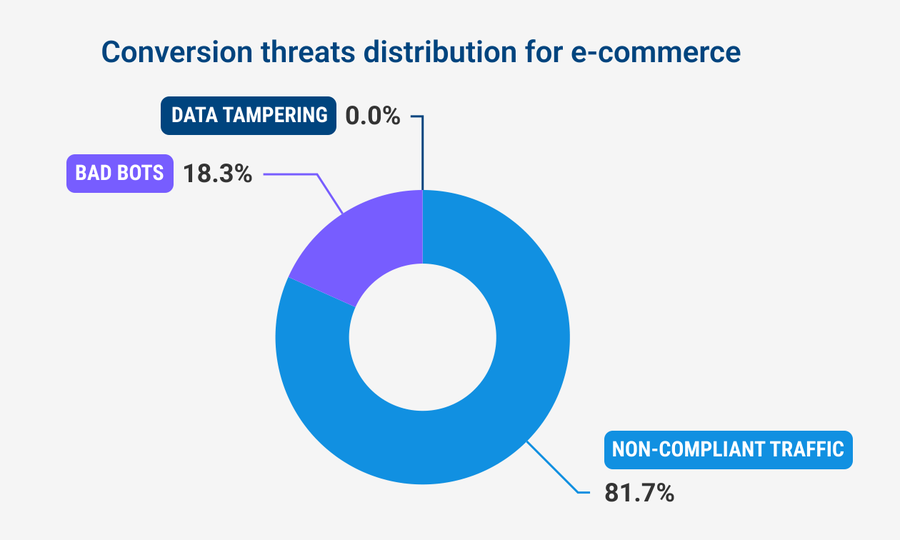
Chart from Opticks’ 2025 Ad Fraud Report (Conversion goal, page 17).
A non-compliant conversion still shows up as a conversion, and the bidding algorithm never learns the difference.
That distinction is why fraud in e-commerce campaigns is so easy to miss by just watching conversion rate. Google’s and Meta’s bidding algorithms still read a non-compliant conversion as a signal of what a “good” shopper looks like. Each algorithm then goes looking for more of them with your next day’s budget.
See the full breakdown behind these numbers, by channel, industry and fraud type.
What to actually do before Black Friday
Stopping e-commerce click fraud before Black Friday does not require new tools. Most of what you can check first sits inside tools you already have.
- ✓Pull the placement report on every Performance Max and Display campaign before raising peak-season budgets, and exclude placements with abnormal click-through or bounce patterns.
- ✓Check the IP and device data behind your highest-converting audiences, the same signal IP risk scoring is built to surface. A spike in data center IPs or repeated device fingerprints is a signal standard analytics will not surface on its own.
- ✓Compare conversion rate by channel, not just overall. A channel converting far above, or suspiciously in line with, the rest of the account deserves a second look right before a sale.
- ✓Set a fraud baseline in a slow month. Then you have something to compare against once peak-season volume makes anomalies harder to spot by eye, the same approach we outline for spotting bot traffic in GA4.
- ✓Add an independent detection layer that blocks invalid clicks in real time, not one that only reports on them after you have already spent the budget. This is the step that actually changes next month’s bidding data, rather than just describing what already happened.
None of this requires pausing campaigns during your highest-revenue weeks. It requires looking at the data you already have through a different lens before the budget goes out the door.
FAQ
Is e-commerce click fraud worse than in other industries?
Not necessarily. Opticks’ 2025 Ad Fraud Report puts e-commerce at 9.65% invalid traffic overall, below higher-risk verticals like B2B (25.37%) or Travel (18.39%), and most of that is non-paid scraping rather than click fraud. See the full ad fraud benchmarks by industry for the complete ranking. The bigger issue for e-commerce click fraud is timing: it concentrates around the exact weeks, Black Friday, Cyber Monday, December, when the most budget and revenue are on the line.
Does Google or Meta refund fraudulent clicks?
Both platforms offer limited invalid-click credits for traffic their own systems flag, but those systems only catch the most obvious bot patterns. The report’s data shows non-compliant traffic drives most fraudulent e-commerce conversions (81.7%), not bad bots. Platform-native tools do not refund that category.
Can fake conversions actually hurt my targeting?
Yes. Google and Meta both use conversion data to decide who to show your ads to next. A fraudulent conversion still counts as a conversion from the algorithm’s point of view. The algorithm then uses it to find “more people like that.” Over time, that pulls your targeting away from real buyers.
What is the fastest thing to check before Black Friday?
Pull the placement report on any Performance Max or Display campaign and look for unfamiliar app or site placements. It is the single fastest place peak-season fraud tends to concentrate, and it takes minutes to review.
Protect Your Peak Season Budget
The bots behind e-commerce click fraud do not look different in November than they do in July. The only thing that changes is how much rides on the traffic they touch. Checking placements, conversion sources and device data before the budget goes out makes the difference between a clean Black Friday and a quietly expensive one. E-commerce retailer UK Soccer Shop found that nearly 1 in 12 of its sessions were not real customers, concentrated heavily in Performance Max and DemandGen campaigns, and recovered 7% of wasted ad spend once it filtered that traffic out, which showed up in lower CAC downstream too.
Get a free, independent read on your e-commerce traffic quality before peak season.
Related reading:
Ad Fraud Rates in Various Channels
The Early Signs of Ad Fraud You Need to Be Aware Of
4 Click Fraud Detection Techniques to Protect Your Campaigns
What Are Click Farms And How to Protect Your Ads From Them
What Are Click Bots and How Can You Prevent Them?
Leave a Reply