


Ever wondered if your chosen advertising channels are as effective as they seem?
The Opticks Ad Fraud Report 2025 analyzed over 2 billion clicks. It covers 500+ advertisers and media agencies. It spans 243 territories, from January 2025 to March 2026. According to this data, ad fraud rates vary enormously by channel. In fact, the picture has shifted since our earlier reports. In this article, we break down exactly which channels carry the most invalid traffic today. We also show you which ones are safer than marketers assume.
- Ad fraud rates by paid channel: what the data shows
- Social networks and apps: a more nuanced picture
- Non-paid channels have invalid traffic too
- Which industries face the highest ad fraud rates
- What type of invalid traffic is most common
- The impact of high ad fraud rates on advertisers
- How to reduce ad fraud rates
- FAQ
Curious how much of your own traffic is invalid? Opticks detects it in real time, across every channel you run.
Start your free trial →Ad fraud rates by paid channel: what the data shows
Our data paints a different picture than many marketers expect. Fraudsters target the entire marketing funnel, from native to programmatic advertising. However, some channels face notably higher rates of invalid traffic than others.
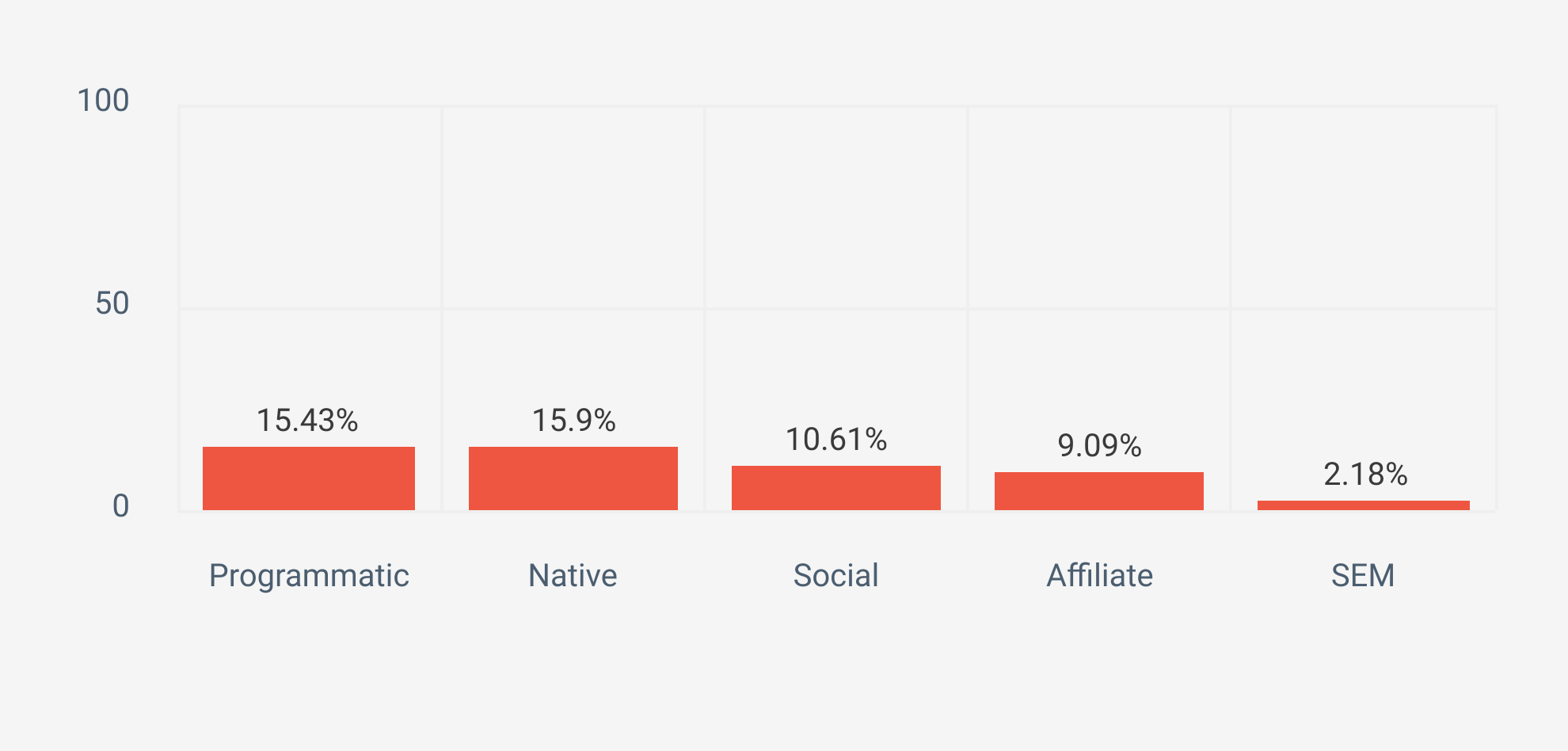
Source: Opticks Ad Fraud Report 2025 (data Jan 2025–Mar 2026).
Native advertising now has the highest invalid traffic rate, at 15.9%
Most native ad networks have measures to detect fraudulent publishers. Even so, fraud persists. For example, sites often sell the same placement multiple times. They stack ads in several layers, so the same visitor “clicks” more than once while only one ad is actually seen. Fraudsters also rely on domain spoofing techniques like cross-domain embedding, iframes, and ad stacking. Some even load ads in invisible windows.
Programmatic advertising is close behind, at 15.43%
Programmatic remains a prime target because fraudsters can hide large volumes of invalid traffic inside it. Usually, they blend in a percentage of real users so some of the supply still converts. This works because the purchasing process is automated at a scale no human team can monitor in real time. As a result, sophisticated device manipulation and proxy techniques go largely unchecked.
Affiliate marketing is now the lowest-risk paid channel, at 9.09%
This is a meaningful shift from what many marketers assume. Affiliate traffic is still a real target for fraudsters, mainly through bots browsing from data centers and VPNs. Reselling and redirect chains also make fraudulent publishers harder to trace. Even so, in Opticks’ latest dataset, affiliate marketing no longer carries the highest rate among the five paid channel types measured.
SEM remains the safest paid channel, at 2.18%
Search platforms like Google Ads and Microsoft Ads have their own built-in systems to limit click fraud at scale. That’s why fraudsters have more limited room to operate here than on other channels. Instead, most SEM click fraud comes from competitors and brand detractors clicking to drain a rival’s keyword budget, rather than from publishers seeking a direct payout.
Social networks and apps: a more nuanced picture
Smartphones account for nearly 64% of the world’s internet traffic. Of that, 90% is spent inside apps. This is exactly why social platforms deserve their own look, separate from the broader “Social” paid-channel figure above.
A few real, verified findings from this year’s report stand out:
- TikTok is the one app Opticks couldn’t cleanly classify. The app generates so much background activity, and uses techniques like site preload and network-fingerprint manipulation, that it’s often impossible to reliably tell a legitimate click from a bot one. Opticks has contacted TikTok about this multiple times without a response.
- Snapchat and LinkedIn show more automated traffic than most other networks. On Snapchat, this is due to adult-content traffic and chatbot activity. On LinkedIn, it’s mostly data scraping.
- Android apps generally carry higher invalid-traffic risk than other mobile ecosystems. This happens through emulators impersonating popular apps, User-Agent tampering, or manipulated WebView rendering.
- Inside “walled garden” platforms, bots are a minor part of the problem. There’s little direct financial incentive for fraudsters on closed ecosystems. So, most invalid traffic there comes from IP-related signals like VPN usage, rather than from bots.
We previously detected large volumes of TikTok click fraud driven by smartphone emulators generating fake views and clicks. This matches this year’s finding that TikTok traffic is uniquely hard to verify.
Non-paid channels have invalid traffic too
Ad fraud discussions usually focus on paid clicks. However, Opticks’ data shows invalid traffic shows up well beyond your ad accounts too:
| Non-paid source | Invalid traffic rate |
|---|---|
| Direct | 40.71% |
| Referral | 18.2% |
| Organic Search | 1.8% |
More than 4 in 10 sessions that land directly on a website, with no referrer information at all, turn out to be invalid. Think scrapers, unidentified bots, and other automated tools. Organic search, on the other hand, is one of the cleanest traffic sources Opticks measures — even cleaner than most paid channels.
Which industries face the highest ad fraud rates
No industry is immune to ad fraud. Still, Opticks’ data points to clear patterns in why certain verticals are targeted more than others:
- B2B, healthcare, and financial services pay some of the highest CPCs in digital advertising. In some countries, B2B companies pay up to $50 per click. That combination of high value and low click volume is exactly what attracts fraudsters and competitors looking to drain a budget quickly.
- Ad Network traffic tends to be cheaper than SEM traffic, and that shows up directly in its quality. Cheaper supply generally means more invalid traffic mixed in.
- Agencies tend to show cleaner traffic overall. This is largely because they concentrate spend on premium channels like Google Ads and Meta, rather than lower-cost inventory.
- E-commerce — especially fashion and car rental — suffers heavily from invalid traffic. But mostly through direct channels rather than paid ones: competitors and other services scrape these sites daily to extract pricing data.
Across the 13 verticals Opticks measured in 2025, paid-channel invalid traffic rates ranged from just above 4% to over 25%. This reinforces that fraud exposure depends heavily on what you sell and who else wants your pricing or budget data — not just which ad platform you use.
What type of invalid traffic is most common
Opticks groups invalid traffic into five threat categories. Here’s the global distribution across all the traffic analyzed in the 2025 report:
| Threat type | Share of invalid traffic |
|---|---|
| Bad Bots | 54.6% |
| Data Tampering | 26.8% |
| Non-compliant Traffic | 12.2% |
| Telemetry Missing | 3.6% |
| Statistical Anomalies | 2.8% |
Opticks identified 416.3 million bots in 2025 alone. Of those, 89.10% were bad bots: automated software attempting to generate fraudulent income. Just 10.90% were “good bots” that openly identify themselves and don’t click on ads or waste budget. With bad bots this dominant, strong bot protection isn’t optional for any channel with real budget behind it.
89.10% of all bots Opticks detected in 2025 were bad bots.
That’s not a rounding error — it’s most of your “traffic” that never had a chance to convert.
Interestingly, the picture changes once you look at actual conversions instead of raw clicks. In a sample of 500,000 conversions, e-commerce invalid conversions were mostly non-compliant traffic like VPN usage (81.7%), with bad bots making up only 18.3%. Lead-generation conversions told a different story: 46.7% bad bots and 40.5% non-compliant traffic. In short, form-based conversions are simply easier for bots to fake than a completed purchase.
The impact of high ad fraud rates on advertisers
Financial losses
Fraudulent clicks and views don’t result in genuine user engagement or conversions. So, high ad fraud rates mean advertisers waste their typically large budgets paying for interactions that can never generate income or positive business outcomes.
Inaccurate performance metrics
Ad success hinges on click-through rates (CTR), conversion rates, and return on investment (ROI). Yet ad fraud distorts all of these metrics. As a result, it becomes difficult for advertisers to accurately measure campaign impact or make informed business decisions.
Reduced campaign effectiveness
Ad fraud diverts traffic away from genuine potential customers. This significantly undermines campaign effectiveness, and makes it harder for advertisers to reach their target audiences and hit their objectives.
Plus, when ads don’t reach genuine users, advertisers find it harder to expand their customer base and drive business growth.
You don’t have to accept these rates as the cost of doing business.
See how Opticks stops it →How to reduce ad fraud rates effectively and efficiently
There’s no escaping the facts: high ad fraud rates have a huge impact on advertisers and marketers. So, maximizing advertising budgets calls for methods that can effectively keep ad fraud out of your campaigns.
Manual methods like IP blocking or blacklisting can combat some instances of ad fraud. However, these approaches are outdated. They fall short of providing the robust prevention advertisers actually need.
Opticks is fraud detection software that also provides click fraud protection. It detects and prevents ad fraud before it has the chance to decimate campaigns — across Google Ads, Meta, Microsoft Ads, TikTok, Taboola, Outbrain and Reddit, plus detection on your direct, referral and organic traffic. That way, advertisers can be confident in genuine engagement and conversions from their target audience.
To learn more about how the expert team at Opticks can improve your campaign performance by eliminating ad fraud, contact us or start your free trial.
FAQ
Which paid marketing channel has the highest ad fraud rate?
According to the Opticks Ad Fraud Report 2025, native advertising has the highest invalid traffic rate among paid channels at 15.9%. Programmatic follows closely at 15.43%.
Is affiliate marketing still the riskiest channel for ad fraud?
No. In the latest data, affiliate marketing has the lowest invalid traffic rate (9.09%) of the five paid channel types Opticks measured — a shift from earlier years, when affiliate fraud rates were higher.
Which marketing channel has the lowest ad fraud rate overall?
Organic Search, at just 1.8% invalid traffic. That makes it one of the cleanest traffic sources Opticks measures — even cleaner than most paid channels.
What percentage of bots are “bad” bots?
89.10% of the 416.3 million bots Opticks detected in 2025 were bad bots attempting to generate fraudulent income. The remaining 10.90% were “good bots” that identify themselves and don’t interact with ads.
Does ad fraud affect direct and organic traffic, not just paid ads?
Yes. Opticks’ data shows Direct traffic has a 40.71% invalid rate, mostly from scrapers and unidentified bots. Referral traffic sits at 18.2%, and Organic Search at just 1.8%.
Is click fraud protection the same as fraud detection software?
Not quite. Click fraud protection is one part of what fraud detection software like Opticks does. Opticks detects invalid traffic and bot protection signals across every channel, but only blocks click fraud and invalid clicks on the paid channels you’re actually running ads on.