

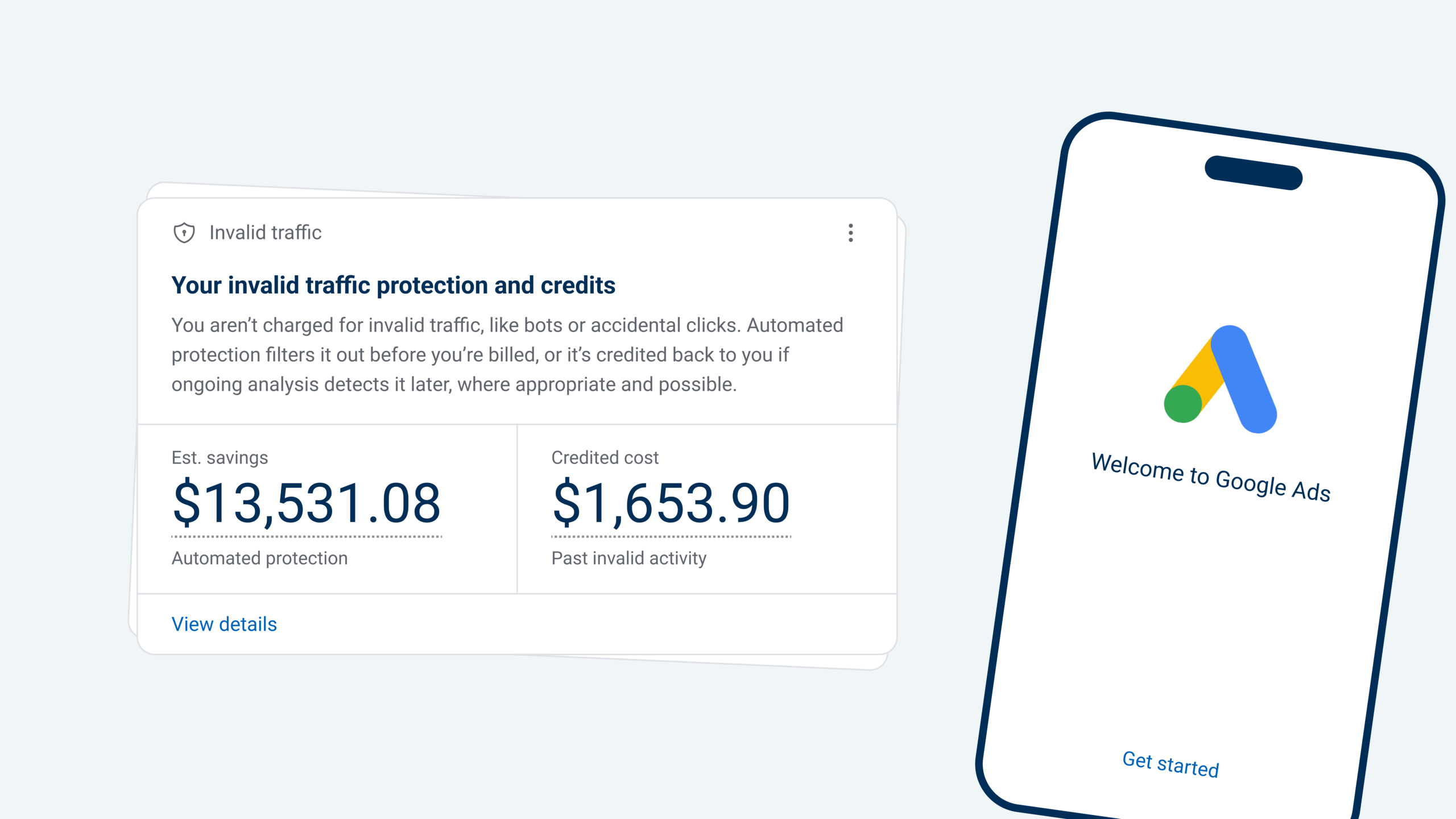
This month a line appeared in your Google Ads account that was never there before. Specifically, it tells you what the invalid clicks in Google Ads cost you, and how much of that money came back. Now go and look for the same line in the newest channel on your plan. It is not there.
That gap is the whole story. For the first time, media buyers can see what invalid clicks in Google Ads were worth, which is the closest thing to a click fraud bill any platform has ever shown them. Meanwhile, they are moving budget into a channel that reports no equivalent at all. In short, the number arrived on the channel that needed it least.
So this post covers what the Google Ads invalid traffic figure means, what ChatGPT Ads reports instead, why nobody publishes a rate for ChatGPT Ads invalid clicks, and how to check your own click quality.
Invalid clicks in Google Ads: the short version
What is the invalid clicks card in Google Ads?
In practice, the Invalid Traffic Overview card is a panel on the Google Ads Overview page, launched on 12 November 2026, that shows two money figures. First, estimated savings is the value of clicks from bots, click farms and accidental taps that Google filtered out before billing you. Second, credited cost is the money refunded for invalid activity found after a monthly billing cycle had already closed. Additionally, clicking View details opens a daily trend chart and a campaign-level table.
However, Google says the card is rolling out gradually, so it may not be in your account yet. In the same announcement, Google stated that it has “reduced advertiser exposure to invalid leads by an average of 30% through continuous system upgrades” so far in 2026. That is Google’s own figure, published without a baseline or a definition of exposure, so treat it as a claim rather than a measurement.
Overall, this is a real improvement. Previously, the honest answer to “how much of my Google Ads spend was invalid” was that only Google knew. Now you get a number. Still, the question is what you can actually do with it.
Four things the invalid clicks card in Google Ads does not tell you
1. The credit for invalid clicks in Google Ads arrives after the auction
To begin with, filtered invalid clicks in Google Ads never reach your bill, which is good. Credited ones do reach your bill and come back later, which is different. By the time the credit lands, that click has already competed in the auction, consumed budget for the day, and fed your Smart Bidding model as a real signal. In other words, money returned is not performance returned.
There is a reporting wrinkle too. Notably, your standard campaign cost columns show charges before credits. The Invalid Activity Credit Report adds an adjusted cost column, your invoiced cost minus the credit, but Google makes it available for Search and Performance Max campaigns only. If you are reconciling spend, know which number you are looking at. We wrote a full walkthrough on how to claim a Google Ads refund if you want to go further than the automatic credit.
2. It is a currency figure, not a rate of invalid clicks in Google Ads
The card tells you how much the invalid clicks in Google Ads were worth, never what share of your traffic they were. An account spending ten times more will usually show larger estimated savings for reasons that have nothing to do with click quality. Google has not published how savings are valued or which campaign types are covered, so two accounts cannot be compared, and neither can your own account month over month if your spend moved.
If you want a Google Ads invalid traffic rate to orient yourself, our Ad Fraud Report puts invalid traffic on paid search at 2.18%, against 15.43% on programmatic and 10.61% on social, from two billion clicks across 243 territories. By comparison, search is the cleanest paid channel most advertisers buy. That is useful context for reading a card that gives you no denominator.
3. It counts a thinner layer of invalid clicks in Google Ads than you think
However, this is the part most people miss. Specifically, Google describes what it filters in three words: bots, click farms and accidental clicks. That is a real category, and it is also a narrow one.
Opticks classifies invalid traffic into five separate threats, and across two billion clicks in the Ad Fraud Report they do not divide evenly:
- Bad bots, 54.6%. Automated software trying to generate fraudulent income. This is the layer everyone talks about, and it is barely half the problem.
- Data tampering, 26.8%. Header manipulation, user-agent tampering and other techniques used to hide the true nature of the device. In effect, a device lying about what it is. A filter looking for automation signatures does not necessarily see it.
- Non-compliant traffic, 12.2%. VPNs, proxies and sources that are harmful in your context even when the visitor is a person.
- Telemetry missing, 3.6%. Devices too old or too restricted to be measured at all.
- Statistical anomalies, 2.8%. Finally, IPs and fingerprints producing click and conversion rates that should not be possible.
Put plainly: more than four out of ten invalid sessions are not classified as bad bots. Therefore a card built around bots, click farms and accidental clicks is showing you the top layer of the invalid clicks in Google Ads, not the whole stack of click fraud and invalid traffic underneath it. It is a useful layer. Still, it is one of five.
Four out of ten invalid sessions are not bots.
See the invalid clicks in Google Ads that fall outside the card, across all five threat types. Five minutes, no credit card.
4. Google is grading its own work
Finally, there is the structural point. Google detects the invalid clicks, decides what counts, and issues the credit. Moreover, there is no independent party confirming the classification, and no way to see the clicks it decided were fine. Nevertheless, this is not an accusation, it is just the shape of the arrangement, and it is the same shape on every walled garden. It matters because the next section is about a platform where even the self-graded number does not exist.
What does ChatGPT Ads report, and what does it leave out?
What ChatGPT Ads Manager reports
By contrast, ChatGPT Ads Manager reports impressions, clicks, spend, CTR, CPC, CPM and conversions, broken out by device and country. However, there is no invalid clicks column, no prompt-level data showing what the user actually asked before the ad appeared, and no log-level export.
Twenty measurement partners, none of them for invalid clicks
In October 2026 OpenAI named its first group of third-party measurement partners, more than twenty firms across four categories: conversion data, attribution, incrementality and brand resonance. However, none of them measures invalid clicks. DoubleVerify and Integral Ad Science do appear, but in brand suitability pilots, which assess the conversation an ad runs next to, not whether the click was made by a person.
What advertisers are already seeing on invalid clicks
Consequently, advertisers are already feeling it. Digiday reported on 1 October 2026 that the agency Accuracast saw ChatGPT “reporting around 100 clicks where its own tracking picked up 20”, and that OpenAI support could not explain the gap. Similarly, another agency in the same piece reported conversions arriving 24 to 36 hours late against a few hours on Google. Conversely, other agencies in the article saw no discrepancy at all, which is exactly the problem: with no shared click quality metric, every advertiser is left arguing from their own anecdote.
Invalid clicks in Google Ads, ChatGPT Ads and Opticks, side by side
| What you want to know | Google Ads | ChatGPT Ads | Opticks |
|---|---|---|---|
| Invalid traffic filtered before billing | A money figure | Not reported | Sessions and share, per channel and campaign |
| Credits for invalid activity found later | Shown as credited cost | Not reported | Not applicable, we do not sell you the clicks |
| Invalid traffic as a percentage | Not published | Not published | Yes, and benchmarked against your industry |
| Threat types distinguished | Bots, click farms, accidental clicks | None | Five, from bad bots to data tampering |
| The same measurement across every paid channel | Google Ads only | ChatGPT Ads only | Yes, every channel from one script on your site |
| Who does the measuring | The platform selling you the clicks | The platform selling you the clicks | You, from your own site |
| What the user searched or asked before the click | Search terms report | Not exposed | The session that followed the click |
| Click-level evidence you can export | No | No | Yes, through Session Forensics |
| Automatic prevention | Google filters on your behalf | Not available | IP and audience exclusion, where the channel allows it |
Status as of 24 November 2026. Google Ads features roll out gradually and may differ by account.
One column your platforms will not fill in.
Measure invalid clicks in Google Ads, ChatGPT Ads and every other paid channel from your own site.
So how many invalid clicks does ChatGPT Ads have?
Nobody publishes that number
Firstly, not OpenAI, which reports no invalid clicks metric. Not its measurement partners, since none of them covers invalid traffic. Consequently there is no platform-wide figure for anyone to quote, honestly or otherwise.
For a channel three months old that is not surprising. It is still a problem, because the budget is moving into it now, this quarter, while the number does not exist.
What the channels with a track record actually show
Instead, the useful comparison is the one you can make against channels that have been measured for years. These are the paid invalid traffic rates in our Ad Fraud Report, from two billion clicks across 500+ advertisers and 243 territories between January 2025 and March 2026.
| Paid channel | Invalid traffic |
|---|---|
| Paid search | 2.18% |
| Affiliate | 9.09% |
| Social | 10.61% |
| Programmatic | 15.43% |
| Native | 15.9% |
Invalid sessions as a share of total sessions. Opticks Ad Fraud Report 2025.
Notably, the spread is seven-fold, and it tracks how long each auction has been policed. Specifically, paid search is the oldest and most defended inventory most advertisers buy, and it is the cleanest. Newer and less supervised inventory sits at the other end.
Why that does not give you a number for ChatGPT Ads
Still, it tells you where to look, not what you will find. A conversational ad surface is not paid search because it sits next to an answer, and assuming it inherits the 2.18% would be exactly the kind of guess this article is arguing against. Equally, assuming it behaves like programmatic would be a guess too.
So the only invalid clicks figure that exists for your ChatGPT Ads spend is the one you measure yourself, from your own site, on the same definitions you already apply to Google Ads.
Google told you what it saved. What about the rest?
Work out what invalid traffic is costing you across every channel in under a minute.
How to check invalid clicks in Google Ads and ChatGPT Ads yourself
One afternoon and access to your own logs. This works for ChatGPT Ads invalid clicks, and on any channel that reports nothing. It also works as a sanity check against the invalid clicks in Google Ads that the card already shows you.
Step 1
Reconcile billed clicks against sessions
Export clicks by day and put them next to your server logs, which no consent banner or ad blocker can suppress. One bad day means nothing. A gap in the same direction week after week is the signal. The agency in the Digiday piece saw five to one.
Step 2
Group sessions by network owner, not by IP
Single IPs rotate in hours. The network that owns the range does not. Sort by ASN and look at the top entries. Hosting providers and proxy networks above consumer ISPs is your answer.
Step 3
Look for sessions with no second event
A click from inside a conversational answer should be high intent. A session that ends in under a second with no scroll and no event is not. Count them as a share of the channel, then compare against your other paid sources.
Step 4
Check device coherence
Screen size, browser, operating system and timezone that cannot coexist on one device. Almost impossible to produce by accident, and one of the clearest signals in the data tampering category.
Ultimately, do this before you scale the budget, not after. The cost of the check is an afternoon. By contrast, the cost of skipping it is a quarter of spend you cannot recover and a bidding model trained on clicks that were never people. Full list of signals in detecting bot traffic and signs of ad fraud.
Or run all four checks automatically.
The reconciliation, the ASN grouping and the device checks, on every channel, without the afternoon.
Where Opticks fits on invalid clicks in Google Ads, and where it does not
Fundamentally, the reason this comparison is awkward is that every number in it comes from the company selling you the clicks. Google grades Google. Meanwhile, OpenAI does not grade at all. Therefore, the only way to get one consistent answer is to stop asking the platforms and measure from your own site.
One definition of invalid clicks in Google Ads and every other channel
Opticks runs from a single script on your site, so every paid visit is scored the same way regardless of where it came from. That gives you one view of traffic quality across Google Ads, Meta, TikTok, Microsoft Advertising, Taboola and Reddit Ads, instead of six dashboards using six different definitions and one channel reporting nothing at all.
That is the practical answer to the ChatGPT Ads invalid clicks problem. Obviously, you cannot make OpenAI add a column. Instead, you can measure the sessions those clicks produce on your own site, with the same five threat categories you use everywhere else, and compare the channel against the rest of your plan on equal terms.
Here is what that looks like with the filter set to two channels at once, Google Ads and ChatGPT Ads, on the same dates and the same definitions.
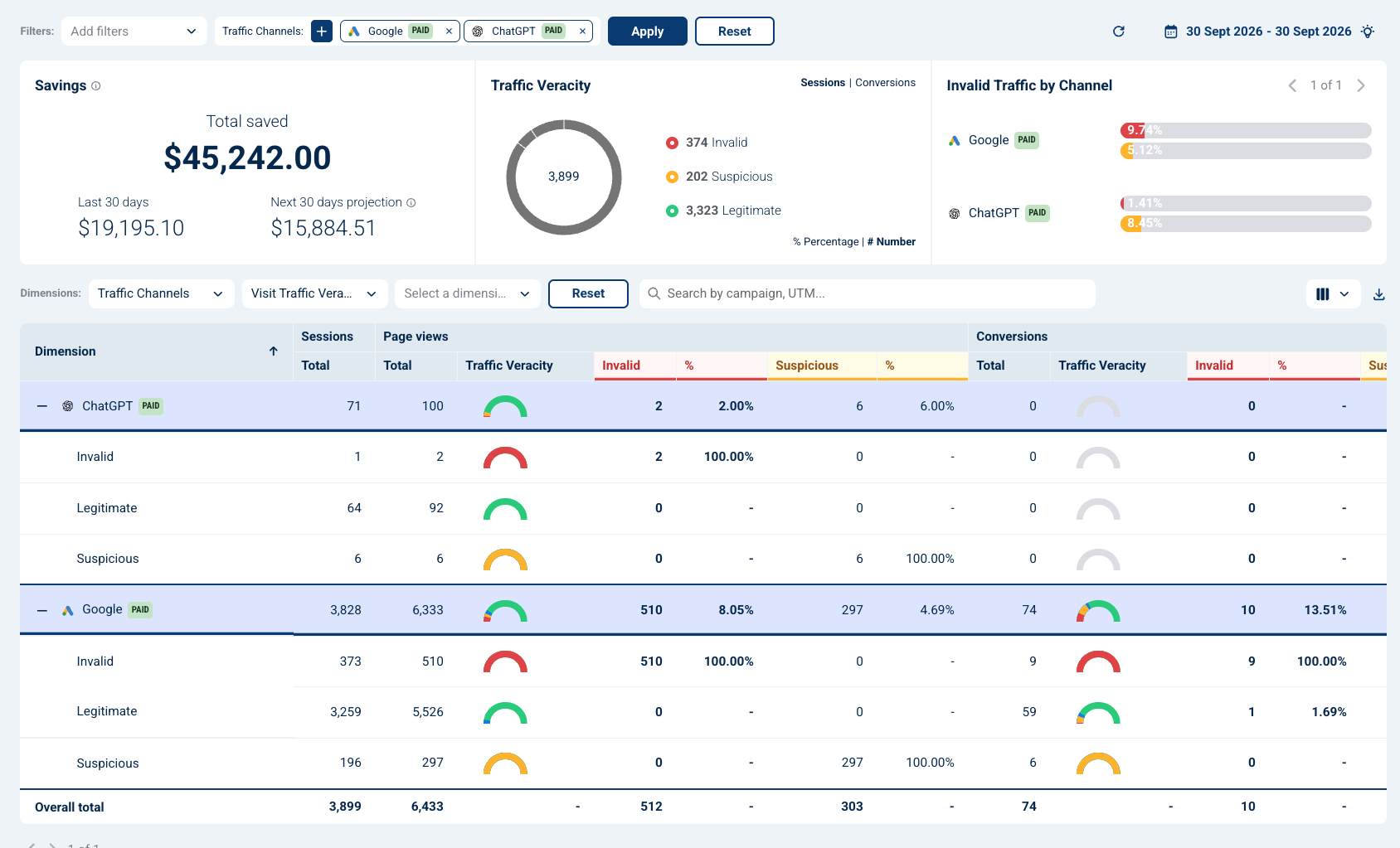
However, read that screen for the capability and not for the rate. ChatGPT Ads contributes 71 sessions there against 3,828 from Google Ads, so its percentages are a sample rather than a verdict on the channel. What matters is that both are measured on the same scale, by the same script, on the same dates.
In Google Ads, detection becomes prevention automatically
As a result, the sources producing invalid clicks in Google Ads are pushed into IP exclusion and audience exclusion lists in your Google Ads account, so the same networks and devices stop being bid on. No list kept by hand. Meanwhile, Google filters at the billing stage. As a result, this stops the spend before the auction.
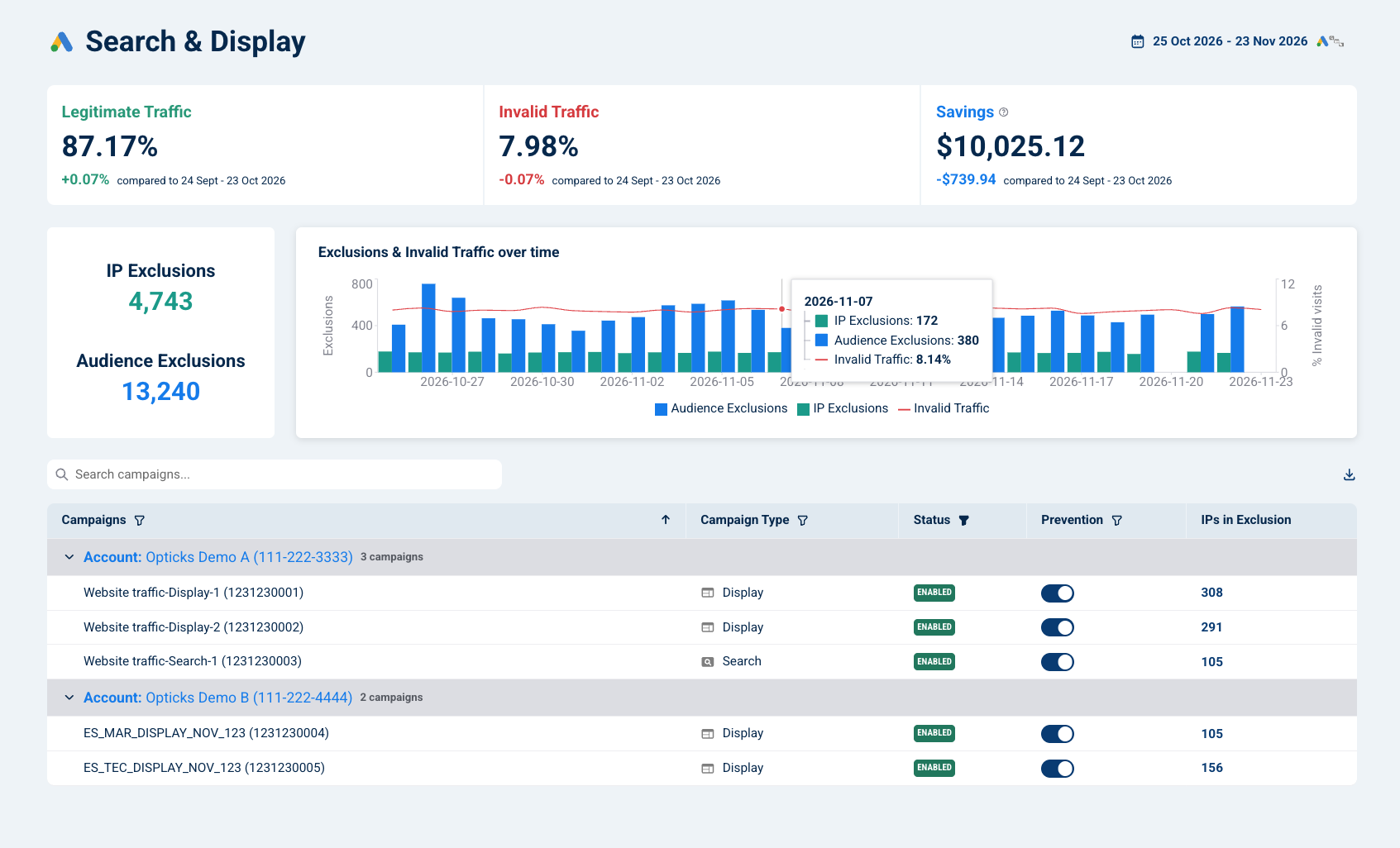
Because the exclusion is ours, the saving is therefore countable. Again, Google’s card gives you a monthly total. This moves day by day, next to the invalid traffic rate that produced it.
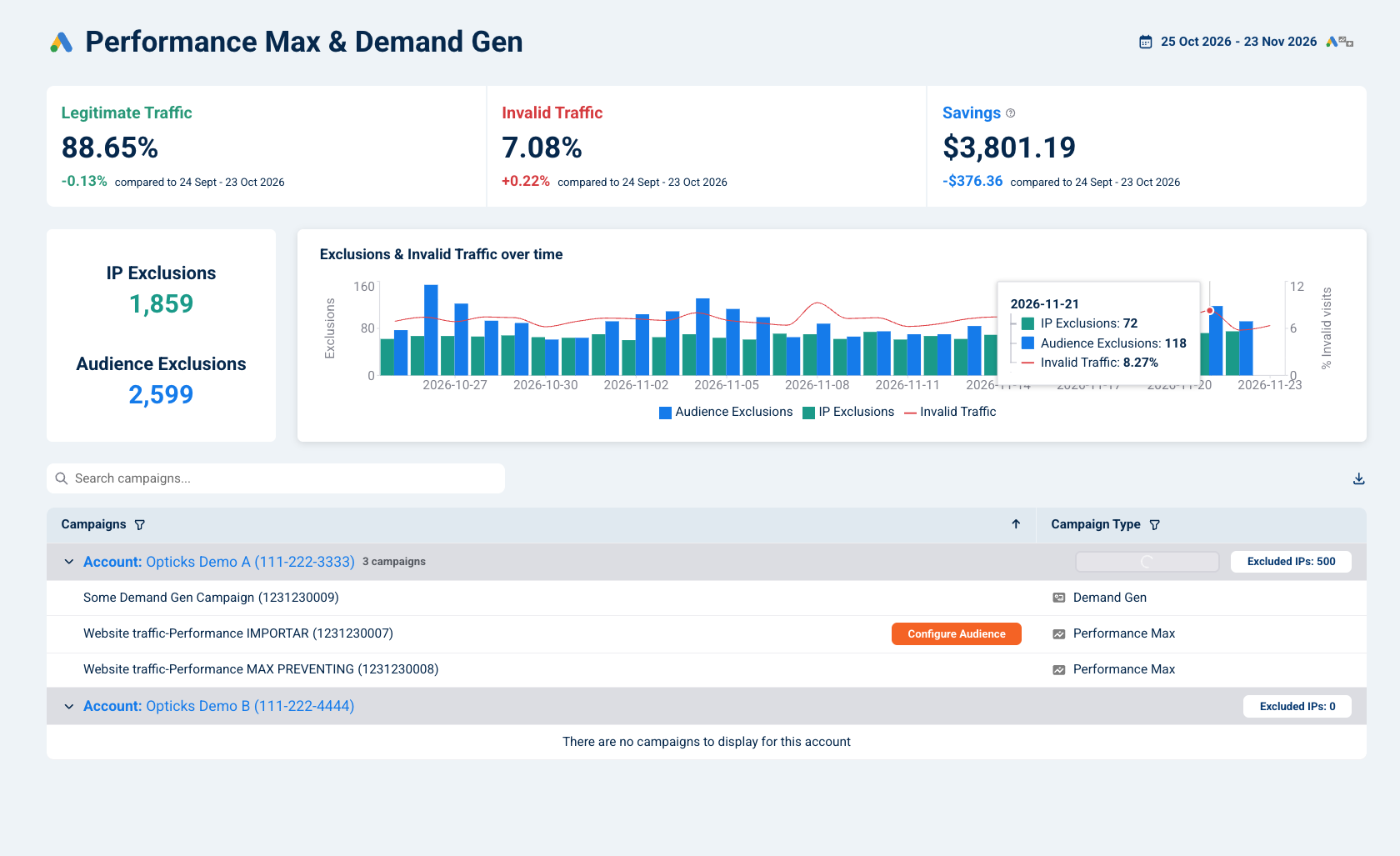
Which campaign types the invalid clicks in Google Ads exclusions reach
However, not every campaign type handles exclusions the same way, so it is worth knowing where the IP exclusion list does the work and where the audience exclusion list does.
- Search campaigns and Display campaigns. IP exclusions are applied per campaign, so each one carries its own list and you can see the count beside it.
- Shopping campaigns. Same per-campaign IP exclusion, with prevention switched on or off campaign by campaign.
- Performance Max and Demand Gen. These behave differently. The IP exclusions sit at account level and audience exclusions carry most of the weight, which is why the audience figure runs ahead of the IP figure on those campaigns.
In other words, invalid clicks in Google Ads get handled wherever Google lets them be handled, and the screenshot tells you which lever moved. Either way, prevention stays switched per campaign, so you choose where it runs.
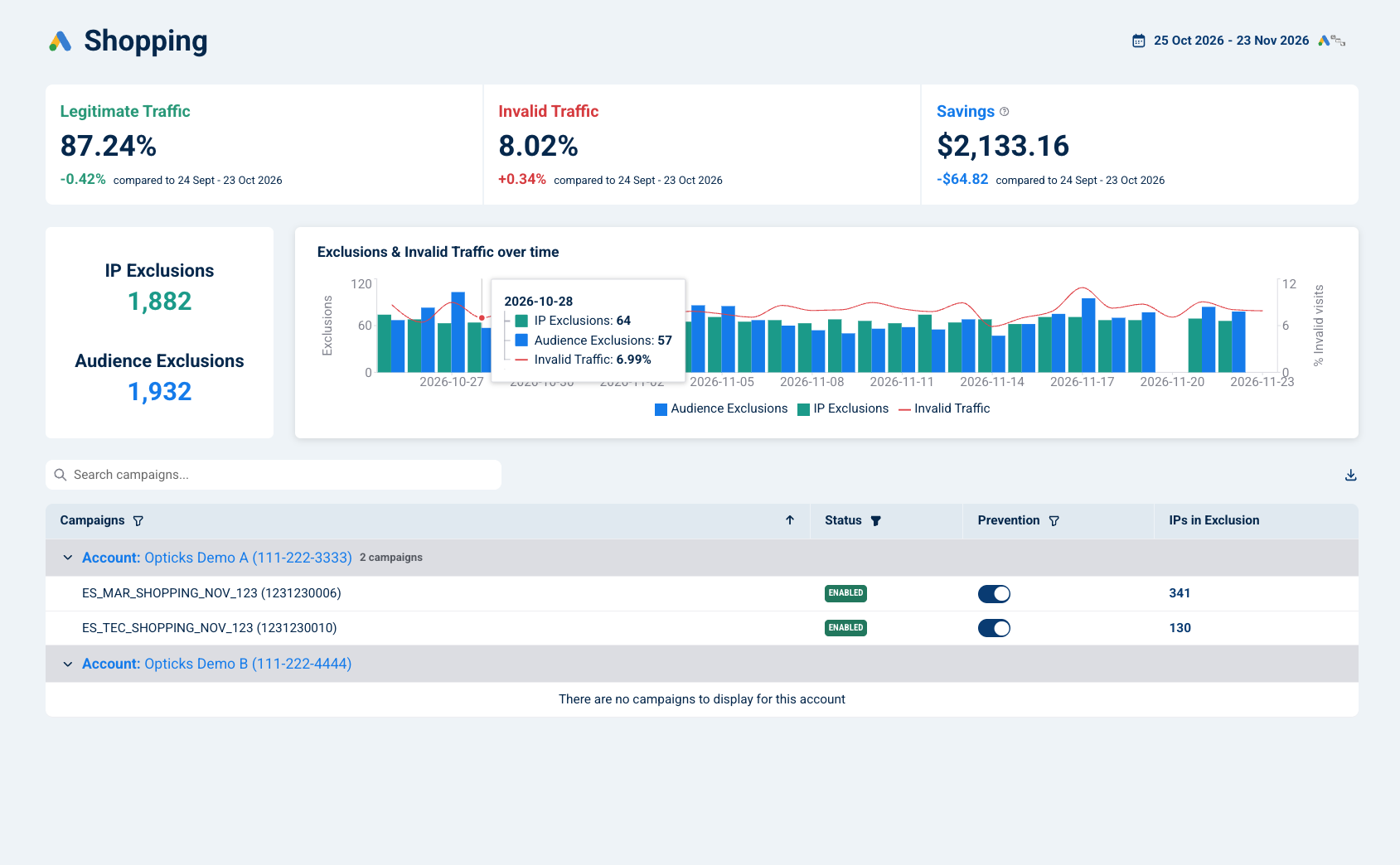
Turn these exclusions on in your own Google Ads account.
IP exclusion on Search campaigns, Display campaigns, Shopping campaigns and Performance Max. Free trial, no credit card.
The evidence to claim money back for invalid clicks in Google Ads
Google’s automatic credits cover the invalid clicks in Google Ads that Google found by itself. For anything else, there is a manual route: the Click Quality form, where you can ask for an investigation into invalid clicks you believe were charged.
However, Google does not accept a hunch. Its own help pages ask for your ten-digit customer ID, the exact dates, the campaigns, ad groups and keywords involved, web server logs identifying the repeat IP addresses, the devices, the GCLIDs of the suspicious clicks, and a short explanation of why the traffic looks wrong. It also limits investigations to the past 60 days, so this is not a task to leave for the quarter review. That is exactly what Session Forensics holds: the click-level record of what happened, which IPs and networks it came from, and why each session was classed as invalid. Then you export it and attach it. We walk through the whole submission in how to claim a Google Ads refund, including the realistic odds, because approvals are far from automatic.
Where we cannot help yet
Said plainly: unlike Google Ads, where invalid clicks can be excluded at source, ChatGPT Ads does not currently expose an exclusion mechanism we can write to. Instead, on that channel Opticks gives you measurement, not prevention. You see what the platform does not report, you can compare it against your other channels on the same scale, and you have evidence to take to your rep or to a budget decision. We would rather tell you that than sell you a block that does not exist.
See the invalid traffic your platforms do not show you
See the invalid clicks in Google Ads that the card never counted, measure ChatGPT Ads invalid clicks the platform will not report, and exclude the sources behind both. Connect through Google Tag Manager in five minutes. No developer, no credit card.
4.9/5 on G2 and Capterra · 6,000+ businesses protected
Frequently asked questions
What is the Google Ads invalid traffic card?
It is a panel on the Google Ads Overview page, launched on 12 November 2026, showing the estimated value of the invalid clicks in Google Ads that were filtered before billing you and the cost it credited back after a billing cycle closed. It is rolling out gradually and may not appear in every account yet.
Does Google refund invalid clicks?
Yes, in two ways. Clicks Google identifies as invalid before billing are never charged. Invalid activity found after a billing cycle has closed is credited back automatically where Google considers it appropriate and possible. Your standard cost columns show charges before those credits.
Does ChatGPT Ads report invalid clicks?
No. ChatGPT Ads Manager reports impressions, clicks, spend, CTR, CPC, CPM and conversions. It has no invalid clicks metric, and as of November 2026 none of OpenAI’s named third-party measurement partners covers invalid traffic or click quality verification.
How many invalid clicks does ChatGPT Ads have?
There is no published rate. OpenAI reports no invalid clicks metric, and none of its named measurement partners covers invalid traffic, so no third party holds a platform-wide figure either. For context, the Opticks Ad Fraud Report puts paid search at 2.18% invalid traffic and social at 10.61%, from two billion clicks. The only rate that exists for your own account is the one you measure from your own site.
Can you exclude IPs in Performance Max and Shopping campaigns?
Yes, but not in the same place. Search campaigns, Display campaigns and Shopping campaigns take IP exclusions campaign by campaign. Performance Max and Demand Gen apply IP exclusions at account level and lean on audience exclusions instead. Either way the goal is the same: stop bidding on the sources producing invalid clicks in Google Ads.
Is click fraud the same as invalid traffic?
Not quite. Click fraud means deliberate clicks made to waste a budget or earn money. Invalid traffic is the wider bucket, and it also covers VPN and proxy sessions, devices that cannot be measured and statistical anomalies that are not fraudulent in intent. Overall, Google Ads invalid traffic reporting covers the narrower end of it.
Can I get a refund from Google Ads for invalid clicks?
Google credits back the invalid activity it detects itself, automatically. For clicks you believe were charged and missed, you can request a manual investigation through Google’s Click Quality form, which asks for dates, affected campaigns, suspicious IP addresses and supporting logs. Furthermore, you need click-level evidence to file it, and approval is not guaranteed.
How do I see invalid traffic on channels that do not report it?
Measure from your own site rather than from each platform’s dashboard. A detection script on your pages scores every paid session the same way regardless of the channel that sent it, which is the only method that produces a comparable number for Google Ads, Meta, TikTok and channels like ChatGPT Ads that publish no invalid traffic metric at all.
What is invalid traffic?
Invalid traffic is any ad interaction that did not come from a genuine person with genuine interest. Specifically, it covers bots and automated scripts, click farms, accidental clicks, and repeated clicks with no conversion intent. See our guide to click fraud for how each type is detected.
Sources
In total, every figure in this article comes from one of these six. In each case, the link opens the original.
From the platforms themselves
-
We’re introducing a new transparency tool for invalid traffic in Google Ads
Google · 12 November 2026
The launch of the Google Ads invalid traffic card, the two figures it shows, and the claim of a 30% average reduction in exposure to invalid leads during 2026.
-
About the Invalid Activity Credit Report
Google Ads Help · accessed 24 November 2026
How credits are issued, and why net figures exist only for Search and Performance Max.
-
Google Ads Help · accessed 24 November 2026
Google’s own definition of what counts as invalid clicks in Google Ads, and the gradual rollout of the card.
-
More ways to measure ChatGPT Ads
OpenAI · 5 October 2026
The full list of third-party measurement partners, which covers conversion data, attribution, incrementality and brand resonance, and no invalid traffic.
From outside the platforms
-
OpenAI’s measurement gaps are keeping ChatGPT ads budgets at test level
Digiday · 1 October 2026
The Accuracast click discrepancy of roughly 100 reported against 20 tracked, and conversions arriving 24 to 36 hours late.
-
Opticks Security · 2 billion clicks, 500+ advertisers, 243 territories, January 2025 to March 2026
The five threat categories and their shares, and the 2.18% invalid rate on paid search against 15.43% on programmatic.
Keep reading on paid channel click quality
Same channel
How To Claim A Google Ads Refund
The card shows the credit. This is how to claim the invalid clicks in Google Ads that it missed.
Same technology
The Dark Side Of AI: ChatGPT And Ad Fraud
What changes when the fraudsters get the same language models you do.
Full picture
Agentic AI, Bot Traffic And Your Analytics
Why a growing share of your non-human traffic is not trying to defraud you at all.
Tools and data you can use today
Free report
Invalid traffic rates by channel and industry, including the 2.18% paid search figure quoted above.
Comparison
The study above is theirs. Here is how the two products actually differ.
Leave a Reply