


You’ve seen a sudden spike in campaign traffic and unusually high click-through rates (CTRs). Your first reaction is to be pleased that your campaign is making inroads where others haven’t. But, when it comes to ad campaigns, if something seems strange, it probably is.
Of course, a spike in traffic could mean anything. A Twitter account with a large audience could have retweeted you, for example. Maybe users are simply finding your latest ad highly relevant to their interests. Or, it might mean that ad fraud is at play.
This is why it’s key to know the main signs of ad fraud. There are many telltale signs that ad fraud is affecting your campaigns, yet fraudsters can disguise many as positive. Here, we explore the early warning signs of ad fraud and how to confirm it’s impacting your campaigns. We also cover the consequences of not preventing it.
What are the early signs of ad fraud?
Knowing the early signs of ad fraud can help you mitigate its impact.
It’s essential to keep a keen eye on your campaign data and analytics and look out for the following suspicious indicators that could suggest that ad fraud is at play.
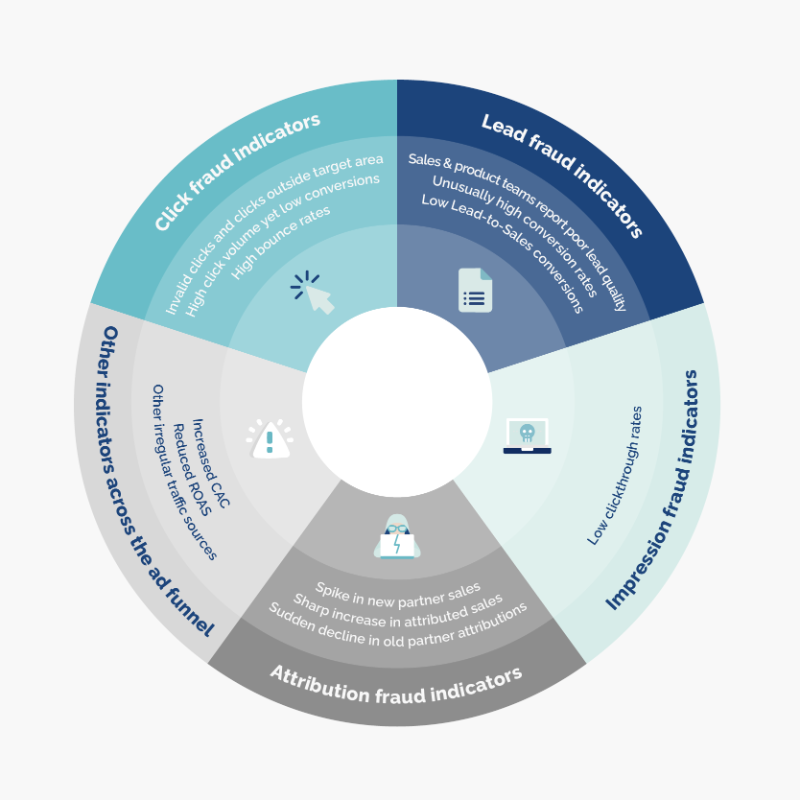
1. Potential indicators of click fraud
While you might think your ad campaigns are doing well, fraudsters could be repeatedly clicking on them. Their sole intention: draining your budgets. Click fraud, a common ad fraud technique, shows the following signs:
- High click volumes coupled with low conversion rates
- High bounce rates
- A high number of clicks from countries outside your target area
- A high number of invalid clicks (on your Google Ads)
- An increase in the volume of clicks while maintaining other metrics and campaign parameters constant (CTR, CPC)
2. Potential indicators of lead fraud
Lead fraud occurs when fraudsters create fake leads to capture financial gains. Since these fraudulent leads will never produce real users, they waste your ad spend and resources. You can identify lead fraud by:
- Unusually high conversion rates from click to lead
- Low conversion rates from Lead to Sales
- Low engagement rates (in Freemium models)
- An increase in complaints from sales and product colleagues about lead quality
- Out-of-target paid leads (e.g. from countries where you don’t have active campaigns running)
3. Potential indicators of impression fraud
Impression fraud occurs when ads are invisible to the human eye, yet systems still count the impressions. The most common forms of impression fraud are pixel stuffing and ad stacking to manipulate ad campaigns for financial gain. The most common indicator of impression fraud is:
- Sudden spikes in the volume of impressions
- Spike in out-of-target impressions
- Low clickthrough rates
4. Potential indicators of attribution fraud
Fraudsters use these methods to steal or fake the attributions for leads or conversions and then receive a financial payout. The following are signs that attribution fraud might be impacting your campaigns:
- Sudden spikes in attributed sales from a new partner: Be wary when a new partner is attributed a significant percentage of sales; it could easily be a case of attribution fraud.
- A sudden decline in attributions from old partners (this is usually a trade-off with the above): When established partner attributions suddenly decrease, it’s time to review what the cause might be.
- A sudden increase in attributed sales (vs non-attributed): When attribution fraud is in place, we often see an increase of attributed sales, whereas non-attributed sales (organic, direct) decreases.
5. Other indicators of ad fraud across the advertising funnel
Other indicators could signal the presence of ad fraud too. Like any other unusual event, however, they need to be properly investigated before they can be attributed to ad fraud:
- Increased CAC
- Reduced ROAS
- Not reaching your acquisition or growth objectives
- Other irregular traffic sources
How can you be sure that your campaigns are being affected by ad fraud?
In many instances, these early signs of ad fraud are indicators that fraudsters are targeting your campaigns. But you need to be sure before taking any action, since the wrong move could hurt your strategy long-term.
To be certain that ad fraud is affecting your campaigns, you need to dig deeper. Two things help here: demanding transparency from your agencies and publishers, and implementing an ad fraud solution.
Demanding transparency from agencies and publishers
Demanding transparency from your agencies and media partners is a crucial step in ascertaining the presence of ad fraud.
For example, your contracts should guarantee direct access to performance data and interfaces from your media partners. Without this performance data, you have no idea where your ad spend goes or where your ads actually appear.
Additionally, you must also reserve the right to access raw campaign data. That gives you insight into what parameters the agency uses to calculate ROI, and helps you pinpoint any early signs of ad fraud.
Implementing an anti-ad fraud solution
Gaining insight into your campaign data can only take you so far in the fight against ad fraud. Without a robust system, these checks and balances fall short of the protection your campaigns and company need against ad fraud.
Anti-fraud solutions can identify, block, and track the most sophisticated ad fraud in real-time. Plus, some systems use advanced machine-learning algorithms and expert rules to differentiate real users from fraudulent behavior. That way, you’re not blocking genuine users.
Put simply, without an anti-ad fraud solution, all types of ad fraud techniques and methods can target you freely. When you implement an anti-fraud solution, you can rest easy knowing it’s automatically blocking ad fraud.
What happens if you ignore signs of ad fraud & don’t actively prevent it?
As well as damage to your campaigns, there are several other consequences of ignoring the early signs of ad fraud.
Ad spend is wasted
Of course, if ad fraud is keeping your campaigns from having the desired effect, you’re essentially misspending your ad budget. Plus, many of the techniques fraudsters use let them capture a substantial share of your campaign budgets. That money would otherwise go to real users.
Furthermore, as total digital ad spend keeps rising, so does the presence of ad fraud. Fraudsters aren’t particular when they choose who to defraud – all industries, verticals, and geographies are vulnerable to ad fraud.
You miss your targets
Ad fraud has a massively detrimental effect on your ability to reach campaign and revenue targets when it goes unnoticed or unprevented.
When you invest time and money into ad campaigns, your main objective is to get them to convert. However, if you’re wasting money on fraudulent traffic and activity, it becomes difficult to reach the goals you set.
Since ad fraud skews campaign performance, teams often mismanage resources and assign them to the wrong activities, leading to missed leads and sales
Your data becomes flawed
Ad fraud ruins the accuracy of your campaign data. False and fraudulent events skew your backend analytics. That means you can’t be sure what’s working and what isn’t. Nor can you know how your decisions will impact your ability to reach your goals and accrue revenue.
For example, when fraudsters carry out pixel stuffing, you’ll likely see high levels of impressions but a low click-through rate. You’d be inclined to believe that this kind of outcome means the campaign isn’t helping you achieve your goals. But in reality, you may well have been hitting it out of the park all along.
It’s time to take preventative action against ad fraud
Ad fraud continues to permeate all corners of digital campaigns across the web. And the only way to stop it from damaging your campaigns is to tackle it head-on.
As the saying goes, “Prevention is better than cure.” Just being aware of the early signs of ad fraud doesn’t go far enough. It’s time to enact robust ad fraud prevention tools to safeguard your campaigns and your business goals.
Anti-fraud solution Opticks can detect and prevent fraudsters’ tactics before these early indicators of ad fraud can even cross your radar.
Want to find out how the expert team at Opticks can help you prevent ad fraud before it starts impacting your campaigns? Contact us now.
Comments
One response to “The Early Signs of Ad Fraud You Need to Be Aware Of”
[…] traffic came out as the most bot-heavy non-paid channel by a wide margin — one of the clearer early signs of ad fraud worth watching […]